















 I love a good thriller. Always have. But I’ll admit that I’m a bit picky. I don’t love all of them, and if I’ve read it before, I don’t want to read it again. When I think of what makes a good thriller, I imagine an older married couple. The husband asks the wife, “Where would you like to go for our anniversary?” The wife says, “I don’t know. Somewhere different. Surprise me.”
As a reader who’s been in this relationship with thrillers for a while, I want what the wife wants: I want a book to take me somewhere I’ve never been before; I want to have no clue where I’m going; and I want to be surprised by what I find when I get there.
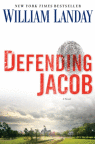
That’s why I loved William Landay’s Defending Jacob. It succeeds on all fronts. Andy Barber is a respected district attorney in suburban Massachusetts, but his world is shattered when his own teenage son becomes the main suspect in the murder of a local kid. From that starting point, nothing goes where you think it will. What results is a sophisticated, deeply disturbing and morally challenging novel that pits a father’s loyalty to his son against his core beliefs in justice and the rule of law.
Not every writer prompts the literary community to offer up praise on a platter, but Landay’s novel has, eliciting advance quotes from Lee Child, Nicholas Sparks, Chevy Stevens and Linwood Barclay (from whom I first heard a rave about this book).
That’s all I’m going to say about it. Pick it up. I can promise that you’ll be led somewhere different, that you’ll never know where you’re heading, and that in the end, you’ll be surprised. What could be more thrilling than that?










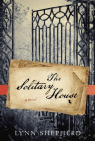 I do love a good historical mystery – ones that give me insight into a time and place gone by. I especially like the early novels of David Liss, particularily A Conspiracy of Paper, and Lynn Shepherd’s new novel The Solitary House is very reminiscent of that wonderful book. Her earlier book, Murder at Mansfield Park, brilliantly reimagined the time of Jane Austen, and The Solitary House explores the gas lit, back alleys of Dickens’ London.