














Because it is a truth universally acknowledged that every person in search of anything whatsoever is eager for publicity.
I used to dream of being interviewed. That and being included in Granta magazine’s regular ten-yearly Best of Young British Novelists issues. It was one of the things which kept me going pre-Curious[1]. I guess it was easier to imagine talking to someone from the Sunday Times, than it was to imagine writing a novel that someone would publish. Indeed, my failure to write a publishable novel was not unconnected to the fact that, in my imagination, doing so was pretty much interchangeable with doling out pearls of wisdom to an expectant public[2].
I’ve been interviewed in real life quite a few times now. Predictably it’s less fun than I’d imagined. As my wife said, early on, it’s like meeting someone at a party, talking to them for half an hour, then seeing them pick up a megaphone, climb on a table and say, ‘Listen up, people. I’m going to tell you what I think about this person’. It’s uncomfortable, however complimentary they are.
The biggest mistake is to think that interviews are a service provided to writers so that they can communicate with readers. The function of interviews is to provide good copy (and most editors will think nothing of ditching interviews if writers have failed to say anything interesting).
So I guess it’s no surprise that many journalists (even journalists I like and respect) take rough notes and reconstruct your quotes later (a few tape the interview and do the same thing). Maybe if you’re a politician or a footballer you don’t notice, but if you spend the greater part of your life trying to get phrases just right, you can’t help feeling uneasy when you appear in print speaking in a voice you don’t recognise.
During one of the very first interviews I did about Curious I was asked whether the book was going to make me a millionaire. It seemed like an impertinent question (discussing advances has always seemed to me a bit like flashing; it’s unpleasant however big it is). And, in truth, I didn’t know[3]. So, I said, ‘Not quite,’ in a tone of voice which sounded, to me, like a polite refusal to answer the question, but which was subsequently translated into the figure, ‘Three quarters of a million’.
During one of the most recent interviews I did about A Spot of Bother I was asked why I’d given up working as an illustrator and I said… well, to be honest, I have no idea what I said, but it certainly wasn’t that I’d given it up ‘because there was no glory in it’, which made me sound like a pillock, and was not very complimentary to everyone who’d commissioned illustrations from me at one time or another.
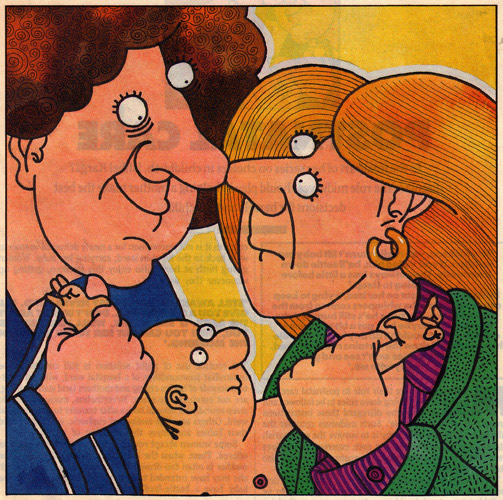
(In grateful recompense to the lovely people at the Nursing Times, who gave me a steady stream of work during some rather lean years, and who provided me with more than enough glory, here is one of the pictures I did for them…)
It’s not lying as such. Actually, it is lying as such. But it’s not something to ring your solicitor about. No-one is accusing you of eating children. It’s just part of the Faustian bargain struck between writers and newspapers. You get to communicate with your potential readers, they get to write something entertaining about you. And if they get a little carried away, well… there’s not much small print in a Faustian bargain. Writers are wary of biting the hand that feeds them. And any interview is better than none, surely. As Simon Armitage once said to me, you get a review saying your latest book is a pile of steaming crap and your Mum says, cheerily, ‘Ooh, look, you’re in the paper again’.[4]
The irony is that interviews are a rubbish way of communicating actual information to readers. I sometimes think it would be more efficient to write them individual letters, put them into bottles and hurl them into the sea. I must have answered the question, ‘How much research did you do for Curious Incident?’
[5] at least 500 times, and journalists still ask it on a regular basis.
The thing that interviews are extremely good for is winkling private information out of unsuspecting subjects. There is something sinisterly flattering about having a nice lunch and a bottle of wine bought for you by an amiable stranger who wants to listen to everything you have to say for an hour. I tend to pass on the offer of wine these days, because it is all too easy to forget that you’re not actually talking to an amiable stranger. You’re talking to everyone in the queue in Tesco’s. You’re talking to your neighbours, your parents, your friends, your GP, your bank manager. It’s just that they’re hiding really well. And it takes a while to learn that casual remarks that mean nothing over a mushroom risotto can cause inordinate amounts of unnecessary crap in your actual life.
(On the spur of the moment I once described my school as ‘like an open prison with really good cultural facilities’, and, well… that’s another story altogether).
I’ve been to quite a few literary festivals over the past few years. As a performer you’re usually offered free tickets to see other writers being interviewed on stage. I’m occasionally tempted. For at least thirty seconds. If I love someone’s writing I’d rather not run the risk of find out that they’re a complete arse. And if I don’t like their writing there doesn’t seem to be much point in finding out what an charming person they are off the page (the last time I went to see an author being interviewed, I subsequently found myself unable to read any more of their books ).[6]
As time goes on, I am more and more inclined to think that these is only answer to all the questions I have ever been asked in interviews: Read the book. It’s great. Honestly.
[1] The first came out in 1983 (Martin Amis, Pat Barker, Julian Barnes…) before I had admitted that this was what I wanted to do with my life. The second, in 1993 (Iain Banks, Louis de Bernières, Anne Billson…), was a painful reminder of my increasingly delusional ambitions. By the time the third came out in 2003 (Monica Ali, Rachel Cusk, Peter Ho Davies…) I had written Curious and, more importantly, turned 40, and was therefore spared the indignity of not being picked.
[2] I don’t think I learnt how to write properly until I realised that having something you wanted to say was actually a hindrance, whereas everything depended on how you said it.
[3] Mostly because the novel had been sold - and was still being sold - to different publishers in different territories for different advances under different contracts. Weirdly, and for similar reasons, neither I nor anyone else knows precisely how many copies of Curious have been sold throughout the world. Someone could certainly sit down and plough through paperwork from fifty or so publishers and come up with a figure, but it seems like a waste of time when the only result would be the ability to brag with precision.
[4] He was talking in general terms and no reference was, or is, intended to a specific review of a book of his. Or indeed mine. I’ve only ever had one genuinely nails-out, eye-scratching review (‘nothing can prepare one for the tendentiousness, the formlessness, the sheer ghastliness of Haddon’s verse’ - brilliant; we almost put it on the cover of the paperback) and my mother never mentioned having read it.
[5] Answer - almost none.
[6] No names, no pack drill.