










Cart | Account

Insiders Blog
Popular Tags
 
2010 April

Fri, Apr. 30th
2010
Writerly Questions with Helen Simonson

We sat down with Helen Simonson to ask her some questions about her life as a writer and her new book Major Pettigrew’s Last Stand. The New York Times declared it “Funny, barbed, delightfully winsome storytelling… As with the polished work of Alexander McCall Smith, there is never a dull moment but never a discordant note either.” Here’s what Helen had to say:

Q. How would you summarize your book?

A. Can a retired Major, in an English village, set aside tradition and obligation to pursue an unexpected friendship and a second chance at personal happiness?

Q. How do you choose your characters’ names?

A. Names seem to pop up along with the characters and I find it is very hard to try to impose something else, once a character has introduced himself or herself. I do remember enquiring about a holiday cottage in England and receiving a very polite reply from a Mrs. Pettigrew. I tucked the name away in my head for future use.

Q. How many drafts do you go through?

A. The poet and former US Poet Laureate, Billy Collins, likes to freak out audiences of aspiring poets by claiming, tongue-in-cheek, never to revise. I tend to revise as I go, line by line and chapter by chapter. When I wrote ‘the end’ I thought it was done. However, between an MFA thesis committee, my agent, and my Random House editor (and I), we must have gone through at least eight sets of notes and suggested revisions; and that was before I was fed to the copy editors like raw steak to tigers. Someone warned me that copy editing was like full body flossing, but I was charmed when my copy editor broke from the standard copy marks to pencil ‘Go Major!’ in a margin.

Q. If you could talk to any writer living or dead who would it be, and what would you ask?

A. I’d like to ask Shakespeare what he thinks of the gravitas now accorded his works, and whether he knew what he was onto when he churned out his little cross-dressing crowd-pleasers. Also, how does he feel that while only the bible outsells him, Agatha Christie continues to pursue him closely from the number three spot?

Q. Who is the first person who gets to you read your manuscript?

A. My husband, John, is a banker, not a writer. Yet he has turned out to be a fine editor and, since he knows me so well, he can spot right away when I’m being lazy. For many years I was in a small writing group in Brooklyn (hi to Katherine, Miriam, Christina and Beth) and there is nothing better than a few trustworthy friends, a cheap bottle of wine and everyone reading pages.

Q. What is the first book you remember reading?

A. I remember in England we had Ladybird books; thin hardbacks with full color pictures on the left and words on the right. There were series after series from just a few words per page to condensed versions of Treasure Island and Shakespeare. They literally colored my childhood reading.

Q.What’s on your nightstand right now?

A. A blistering modern Indian novel that was the 2008 Man Booker winner, called White Tiger, by Aravind Adiga (Free Press). A new (Bloomsbury Publishing) reissue of wonderful 1931 novel called The Brontes go to Woolworths by Rachel Ferguson, which is a comedy with strange, dark edges. Cathleen Schine’s The Three Weissmanns of Westport, a modern reimagining of Sense and Sensibility (I received an advance copy - one of the more delightful perks of being an almost published writer).

Personally, I think this would make a great pick for book clubs. You can read the entire interview with Helen Simonson here, or read an excerpt from Major Pettigrew’s Last Stand here.

Posted in Fiction | Permalink
Tags: ,
Trackback URL: http:​/​/www.booklounge.ca​/blogs​/2010​/04​/writerly_questions_with_helen_simonson​/trackback​/

Tue, Apr. 13th
2010
The Dewey 24 Hour Read-a-thon

What’s a Read-a-thon, you ask?

In October 2007, Dewey, from the blog “The Hidden Side of the Leaf” (which has since been taken down) created the 24 hour read-a-thon with the intent of getting all her blog buddies to participate for a whole day of reading. It started with 69 participants, then 119 people and the current amount of people that participated on Saturday April 10th, 2010 was a grand total of 388 participants.

Unfortunately, Dewey passed away in November 2008. But the Dewey’s 24 Hour Read-a-Thon continues to flourish, with events taking place twice a year (April and October). The idea is to read non-stop and blog about your experience, while also participating in all the fun events that are happening over at the main read-a-thon webpage. Each hour was filled with memes, contests, challenges and lots of cheering from the cheerleaders.

I woke up at the crack of dawn on Saturday morning to get prepared for my assigned time - 8:00am. With tea in hand, I began my first book and read straight through until 1:00am. I made my lunch with a book in hand, I ordered takeout so I wouldn’t have to take a break from reading and I consumed two red bulls to assist with any fatigue I experienced. It was a great experience and I even won two books from the prize list!

Some people participated for fun and some set goals to read for a purpose. My goal was to read as much as I could and donate $5.00 for every book I read to First Book, an organization that provides new books to children who might not have the opportunity to get books on a regular basis.

I completed 5 books over the span of 17 hours, that’s a grand total of 1149 pages. I’d say it’s a win-win, because I got to tackle my never ending “to be read” pile and First Book gets to help children start to become lovers of reading.

You can read all about the books I picked and my progress over on my blog, Reeder Reads.
Posted in Adventures in Publishing | Permalink
Trackback URL: http:​/​/www.booklounge.ca​/blogs​/2010​/04​/the_dewey_24_hour_readathon​/trackback​/

Thu, Apr. 8th
2010
The Benefits of Summering to a Writer

I’m a Southerner born and bred, and I grew up going to the beach for a couple of weeks every year in South Carolina, where the water is warm as your bath, the pace is slow, and the fake-bamboo furniture is comfortable. Then, after a move to Boston that still baffles even me, I met my husband, who summered. (In all fairness, his family would be loath to use that word; nevertheless, when you decamp to the coast for the entire summer, every summer, that’s summering.) Moreover, they summered on Cape Cod, in a very old house built to withstand howling winter winds (small windows, fireplaces, and low ceilings), and where the decor was not, um, tropical. The water was often freezing. The air was often freezing. In August.

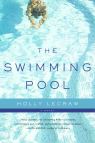
As I’ve begun talking to people about my debut novel, The Swimming Pool, I’ve noticed that one of the most popular questions people ask is “Where did you get the idea for your book?” and that, often, what they are really asking is, “Is it autobiographical?” It’s hard to believe that writers make up stories out of thin air, and for good reason: they don’t. Somewhere, in every book, there are elements hidden of the writer, of the writer’s family, the writer’s history and experience. The best description I have heard is “refracted autobiography” - emphasis on refracted. For instance, The Swimming Pool is the story of a young man, Jed McClatchey, who is mired in grief for his parents, who died seven years previously - his mother in a still-unsolved break-in/murder. Jed falls in love and begins an affair with an older woman, Marcella Atkinson, who he then learns was his late father’s mistress; as one might imagine, complications and revelations ensue.

Now. I am happily married. My parents are both alive. I don’t know anyone who was murdered. I am not Italian (Marcella is). I don’t know any cougars personally. It is all made up.

Except for the fact that this book is set on Cape Cod, and Marcella, an expatriate from a warm and sunny clime, is mystified by it. And except that Jed, who just happens to be a Southerner, has grown up summering there. Which is not usual for a boy from Atlanta. One might say that I have split myself between my two protagonists: I have the woman who feels like a constant outsider; I have the man who loves being somewhere different, who knows how different it is from his birthplace and yet who gets it. Because I think I finally get the Cape, after twenty-something years. Or maybe I just get it enough to fake it. I can still stand a bit outside. I can see it clearly, in a way that it is sometimes hard for me to see the places where I grew up.

It is the quintessential stance of the writer: you’ve got to blend in. You’ve got to pass. You’ve got to get people to forget that you’re watching, hard. And, really, they shouldn’t be nervous; the things writers notice, or that I notice, anyway, are not the things one might expect. In this case, there was a story I heard long ago about a family I barely knew, where the middle-aged husband left his high-school-sweetheart wife - a sad, but garden-variety, occurrence. For some reason, it stuck in my head. And then it combined with the feel of the sun beating down on a clay tennis court in the woods (a court I decidedly watched from the outside; I couldn’t hit the broad side of a barn with a tennis ball), with the cast-in-amber interior of a beloved old Yankee house, and with the sort of crime one might read about in the newspaper and then promptly forget. My own experience with postpartum depression was given to a secondary character, and intensified. My one trip ever to the Connecticut coast yielded a place for Marcella’s escape. And on and on.

Where did I get the idea for the book? I have no idea. Is it autobiographical? Of course not. Of course.

As it happens, I still get to go to South Carolina occasionally, often in August, when I can sweat to my heart’s content. As it also happens, I wrote much of the book on the Cape. I belong to both places, and to neither. As a writer, it’s better that way.

Posted in FictionGuest Posts | Permalink
Tags: ,
Trackback URL: http:​/​/www.booklounge.ca​/blogs​/2010​/04​/the_benefits_of_summering_to_a​/trackback​/


Search


Recent Posts


Follow Us on Twitter


Subscribe


Links


Click here for more information