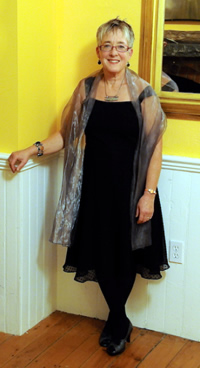
 Last Thursday, I was invited to read from my memoir Edge Seasons at The Eclectic Reading Club. It is a private club, whose evenings are black-tie events. I wore my little black dress and grey silk scarf. Peter had the usual struggle with his bow tie. It was a foggy November night, and we drove cautiously down the highway to the Rothesay exit, where we convoyed with the woman who had invited us. Through the fog we went, beneath tall trees, over a leaf-softened lane. An enormous house loomed from the mist, light shafting from windows, men in tuxedos and women in evening dress crossing the porch.
The scene was not that different from the way it must have been in 1870, when the club was formed in Saint John by a group of people who decided to dress up and entertain each other. Every particular of the evening has been maintained with scrupulous care, from dress code to refreshments to the evening’s unvarying format. Although the house was new, the two adjoining living rooms had the look of a Victorian parlour, with rows of chairs, a standing lamp with shade, and an old desk in what was the “stage” area. The recording secretary sat at the desk, pen in hand. Seats were taken with rustlings of silk. Minutes from the last meeting were read with spirited humour. Then the evening began, exactly as if we’d been transported to a damp, lamplit evening one hundred and forty years ago.
The evening is always planned by one person, who decides on a theme, chooses readings to illustrate it, and asks members to read or perform (“eclectic” being paramount). The event began with an introduction by Carole, the evening’s planner, consisting of a history of the season and its pagan underpinnings. In this first twenty minute segment, four people rose and stood beside the lamp, reading aloud. We heard an early Dickens Christmas story, Robert Louis Stevenson’s “Christmas at Sea,” a Maigret story, and Hugh Oliver’s “The Christmas Gift.”
A break for drinks. We milled and circulated, carrying glasses of wine.
The second twenty minute segment commenced with a stir. Four tuxedoed mummers wearing masks, capes, and wigs burst into the room - St. George, the dragon, a doctor and a narrator. The dragon was stabbed, and expired before our eyes with a flowering of blood caused by the extravagant flailing of a scarlet chiffon scarf. Once the shrieks of laughter had eddied to a pause, with occasional eruptions of half-stifled giggles (mine among them), I took my turn by the lamp and read my piece, “Christmas Rites,” to an attentive, refocused audience.
Another break for drinks. Peter’s cough was quelled with Scotch.
In the last segment, we were treated to Dylan Thomas himself - lilting and rollicking his way through “A Child’s Christmas in Wales.” And then, led by a strong soprano voice, a lusty group singing of “The Holly and the Ivy.”
The evening ended with plates of sandwiches and hot chocolate with whipped cream dense as Devon clotted cream.
Loose and jolly, transported to another time and in a holiday mood despite the mild weather, we took our leave.
I loved every minute, and I hope we’re asked back someday.
















 who was in Toronto to promote his book We’ll be Here for the Rest of Our Lives. I loved all the musical connections this man possesses and he shared his newfound knowledge with anyone at the office who would listen.


