















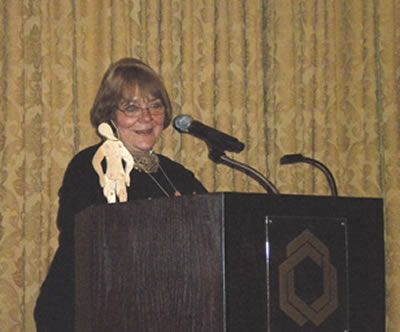
The Derrick Murdoch Award, awarded for ‘contributions to Canadian Crime Writing’ is one of those ‘lifetime achievement’ awards that makes the recipient check her pulse to make certain she’s still in the land of the living. Well, I am, and glad of it. I’m also glad to have received this particular award because it’s encouraged me to reflect on the changes in Canadian crime writing since my first Joanne Kilbourn novel appeared in 1990.
When Deadly Appearances was published there was an advertisement promoting Canadian crime writers. It consisted of mug shots of writers like Howard Engel, Eric Wright, Medora Sales and Alison Gordon. I think perhaps the total number of writers represented was ten. I would love to see a similar ad promoting Canadian crime writing today - not just because our numbers have grown exponentially, but because those mug shots would reveal some significant facts about us as Canadian crime writers. We are a diverse group: male and female; gay and straight; young and old; rural and urban. We come from widely divergent ethnic and religious backgrounds. We are from every part of Canada and we write about every part of Canada. Collectively, we give the world a significant literary picture of what it means to be a Canadian in the year 2009. That is no small achievement.
When Derrick Murdock, after whom the award is named, began reviewing crime fiction for The Globe and Mail, the books that came across his desk were primarily written about places other than Canada. This is no longer the case. To write simply about Canadians and Canada would be parochial and impoverishing but not to write about ourselves would be to contribute to the problem Margaret Atwood identified in her seminal work, Survival. In that book she used a powerful metaphor to illustrate the need for a national literature. Atwood asked what would happen to a person who every morning looked into a mirror and was given back a reflection of someone other than herself.
Through our work, Canadian crime writers have given readers here and throughout the world images of the Canadian identity in all its diversity and vibrancy. This, too, is no small achievement.
In the almost two decades since my first book was published, perceptions about the calibre of Canadian crime fiction have changed radically. When my second novel Murder at the Mendel was published in 1991, I appeared on a panel with a number of other academics. Our topic, if I remember correctly, was “Do Mysteries Matter?” The consensus seemed to be that they did not. One of my sister panellists said that she regarded women who wrote crime fiction as akin to the 19th century women who painted china. She believed that neither those 19th century china-painting women nor 20th century mystery-writing women had the courage required to attack the big canvas or the serious novel.
Canadian crime writers are no longer regarded as practitioners of a lesser art. Our books are now on the curricula of universities throughout the world. Theses and learned papers are written about us, and we are regularly reviewed and discussed by thoughtful readers who value our contribution to literature.
Last week I received an email from two young female academics asking if I would write an introduction to a book of essays on Canadian Detective Fiction. The book will be published by Wilfred Laurier Press, a publisher of serious and handsome books. The young academics made a point of noting that their book will be “the first in the field”. In my opinion, it’s about time.