Cart | Account

Insiders Blog
Popular Tags
 
2007 October

Wed, Oct. 31st
2007
The Dirt on Stinky Armpits

Although our ancestors were much more relaxed about body odour than we are, I did find the occasional ancient deodorant recipe—like the 16th-century French one that recommended a compound of roses to counteract “the goat-like stench of armpits.” The first generation of commercial deodorants, at the end of the 19th century, tried to close the pores with wax, but in 1907 a Cincinnati surgeon invented the first modern deodorant. It was called Odorono (“Odor? Oh no!”), and it inhibited perspiration with aluminum chloride. A century later, our choices of deodorants are vast. And so are the problems associated with that choice, as I learned this week from two good sources, Heidi Sopinka’s Footprint column in The Globe and Mail, and Adria Vasil’s book Ecoholic.

Although the link between aluminum and Alzheimer’s disease remains unproven, many people avoid antiperspirants, which almost always contain aluminum. Lots of antiperspirants and deodorants contain paraben, a preservative that is potentially carcinogenic. So is talc, and its illegal mining endangers Indian tigers. Even so-called natural deodorants contain propylene glycol—better known, in 100% concentrations, as antifreeze. Aside from not wanting to smear antifreeze on your armpits, it’s very harmful to aquatic creatures.

Bewildering as this sounds, Sopinka offers some sensible advice: “Avoid antiperspirants entirely, and if after reading the label you find no mention of parabens, talc or propylene glycol, you’re on the right track.” Even simpler, you could experiment with a regime more and more people are telling me about: do without deodorant and rely on soap and water. When Kermit the Frog complained about how hard it was being green, he must have been thinking about deodorant!

Posted in Canadian | Permalink
Trackback URL: http:​/​/www.booklounge.ca​/blogs​/2007​/10​/the_dirt_on_stinky_armpits​/trackback​/

Mon, Oct. 22nd
2007
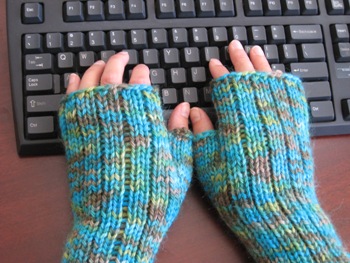
Knit Your Own Mitts

I received my copy of the Knitter’s Book of Yarn, and oh boy, was I excited! I knew it would be full of useful information on what yarns are made of, what they can be used for and how to substitute them, but I didn‘t know the patterns would be so great! There are 40 of them and each one has two choices for yarn as well as how to substitute with whatever yarn you want to use in the same ply. I took the book home, dipped into my stash, and whipped up this pair of “Maine Morning Mitts” over a rainy Saturday while the power was out. I‘ll be using them in the office all winter!

You can try this one too! The author has a free download of this pattern on her site. Happy knitting!

Posted in Adventures in PublishingNon-Fiction | Permalink
Tags: ,
Trackback URL: http:​/​/www.booklounge.ca​/blogs​/2007​/10​/knit_your_own_mitts​/trackback​/

Wed, Oct. 17th
2007
The End of a Tradition: Part 2

I wrote about my many days of collecting butterflies in my new novel Turtle Valley, how I found the butterflies on the shoulders of country roads by alfalfa fields where they had been struck by passing vehicles. As I wrote in the novel, in these areas butterflies “littered the ground like yellow confetti” and when I picked them up, “the luminous scales from their wings dusted (my) fingertips like eye shadow.” These insects became a precious commodity for me, a gift that I collected by the dozens and stored in boxes, a bit of summer that I would pull out to laminate onto bookmarks on cold winter evenings. It should come as no surprise, then, that my working title for Turtle Valley was “A Hatful of Tattered Butterflies.”

There’s a bit of irony here, that I would immortalize the act of collecting these butterflies within the novel that marks the end of my homemade bookmark tradition, because it has come to an end, at least for now. I hesitate to say I’ve retired from this venture altogether, as so many authors claim to have given up writing, say, only to come out of retirement when a good idea (and an empty pocketbook) strikes. But I now have a blended family of four kids, I teach in the UBC Creative Writing MFA Optional-residency program, I’m at work on the next novel project, and I have a new, high tech hobby — blogging and running a forum — so there is little time left over in the day for seeking out dead bugs.

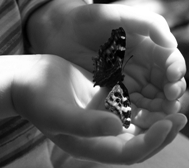
Still, I very much miss this exercise. When I hunted for materials to create my bookmarks, the world was suddenly full of riches. As Annie Dillard wrote in Pilgrim at Tinker Creek, “…if you cultivate a healthy poverty and simplicity, so that finding a penny will literally make your day, then, since the world is in fact planted in pennies, you have with your poverty bought a lifetime of days.” When I made bookmarks, finding the iridescent wings of a dragonfly literally made my day, as did stumbling across a clutch of skeleton leaves beneath a poplar, or, of course, finding the dead butterflies windblown and clustered along the roadsides like the petals from an ornamental cherry. I see these “pennies” less and less myself now, though I know they are there: my five-year-old spots and gathers them on our walks together, for his morbid and beautiful collection of dead butterflies and beetles, rocks, flowers, leaves and bones that he rightly calls his “treasures.” He whoops as he scoops up the pennies that I pass by. Still, the strange joys of this old hobby of mine linger on. When a butterfly flew through the open door into our house today, and my son captured it against the window within his cupped hands, I couldn’t help but notice the beauty of the insect’s wings, and how lovely they would have looked on one of my bookmarks.


Posted in Canadian | Permalink
Trackback URL: http:​/​/www.booklounge.ca​/blogs​/2007​/10​/the_end_of_a_tradition_part_2​/trackback​/

Fri, Oct. 12th
2007
Cleaning Up at the ROM

Often it’s hard for me to remember where I first got an idea for an article or book. But in the case of The Dirt on Clean, I can pinpoint it exactly. In the spring of 2003, Toronto (where I live) was the city outside Asia that was hardest hit by SARS. I was washing my hands 10 times more than usual and ruminating about the connection between washing and disease. At the same time, I happened to visit the 18th century rooms in the Royal Ontario Museum. A painting of a crowd was captioned, “The aristocrats in this picture are just as dirty as the peasants.” I don’t usually listen to audiotapes in museums, but I pressed the button and listened to a short tape on the subject.

What I learned was that the medieval Crusaders brought back the custom of bathhouses from the Near East. Medieval folk bathed together in communal baths, until the plagues frightened them into believing that sickness entered the skin through water. Most of the bathhouses closed by the 15th century and for the next couple of centuries, Europeans shunned water, wiping hands and faces without soap, and leaving the rest untouched. Wearing white linen, or “the linen that washes,” as it was called, substituted for real washing.

Listening to this, the proverbial lightbulb went on. By its light I saw a book title: Clean: The History of a Notion. The title evolved. But my sense of an intriguing subject, centred on the body but with connections to sexuality, disease, religion and other “big” ideas, remained pretty constant. I owe the ROM a thank you.

Posted in Canadian | Permalink
Trackback URL: http:​/​/www.booklounge.ca​/blogs​/2007​/10​/cleaning_up_at_the_rom​/trackback​/

Thu, Oct. 11th
2007
Keeping Up With the Best New Work

One of the best things, as well as one of the most difficult things, about being an editor is trying to keep up with the best of new work, not only in Canada but from around the world. As you can imagine, the prospect gets even more daunting when you take into consideration all the books published in French, in Japanese, in German, in Spanish…I mean, someone had to tackle the first English translation of Haruki Murakami and Gabriel Garcia Marquez.

When I recently took up a new position at McClelland & Stewart, I was especially excited to discover that one of the novels just on the cusp of being published here was Voice Over by Céline Curiol. This debut garnered extraordinary praise (including from Paul Auster) when it was published in France in 2005.

Auster called it “brilliant”: a perfect word, because the work is both intelligent and something of a sharp-edged, polished jewel. I read it obsessively, not the way you sometimes do novels that are like slipping into a warm bath (nothing wrong with that) but with something more like a mental adrenaline rush. Curiol writes so unblinkingly and subtly about the path of one woman’s obsessive love that anyone who has ever found themselves on an emotional precipice and wondered how on earth they got there—or wondered how someone else wound up in that dangerous place—will be mesmerized. And her Paris, with the packed rush-hour metro, the drag bar, the menacing nighttime streets, will give you a whole new perspective on the City of Light.

I can’t wait to hear Céline Curiol read from Voice Over at this year’s International Festival of Authors in Toronto, on October 19th — and she’ll be at the Festival in Ottawa too, on October 16th. Kudos to both festivals for helping bring the world to us.

Posted in Canadian | Permalink
Trackback URL: http:​/​/www.booklounge.ca​/blogs​/2007​/10​/keeping_up_with_the_best_new_w​/trackback​/

Fri, Oct. 5th
2007
Thien Wins First Novel Award

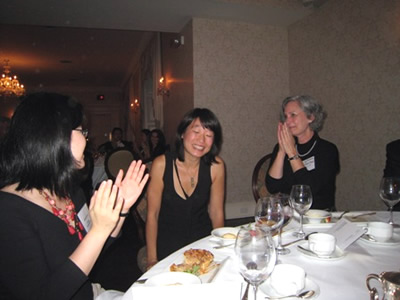
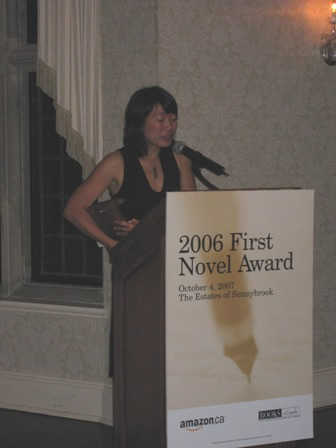
Last night, I had the privilege of attending the Amazon.ca/Books in Canada 2006 First Novel Award. Of the 6 finalists, we had one contender from McClelland & Stewart, the lovely Madeleine Thien, who was one of the guests at the table I was seated at. After a dinner of butternut squash ravioli covered with warm, melted heaps of delectable cheese the editor of Books in Canada introduced the judges and talked about the finalists. They each gave a reading followed by a dessert of a warm apple tart with caramel and maple ice cream for dessert, and then came the moment we had all been waiting for—the announcement of the winner. I am happy to report that Madeleine was the very deserving recipient of the $7,500.00 prize for her novel Certainty! Her acceptance speech was gracious and eloquent just like Madeleine herself. And to think, minutes before she was telling us how excited she was to be able to buy books with the $750.00 gift card all the finalists received.


Madeleine Thien surprised by the announcement.


Thien during her acceptance speech.

Posted in In the News | Permalink
Trackback URL: http:​/​/www.booklounge.ca​/blogs​/2007​/10​/thien_wins_first_novel_award​/trackback​/

Wed, Oct. 3rd
2007
The Head Trip Part 2: Science Writing

In keeping with the associative spirit of my last blog entry, I would like to make some wild generalizations about science journalism. I would say that most science journalism is inherently conservative. That is to say, science journalists want to get it right, so they often ground their arguments in consensus. Like Bill Bryson’s A Short History of Nearly Everything or Jay Ingram’s Theatre of the Mind, they do chart the disputes, but the knowledge they deal in is essentially consolidated knowledge. It’s the hard foundational matter on which the sturdy edifice of workaday science is built. This is terrific and important science writing, the kind I love to gobble up, but it is not really the kind of science writing that I do.

I prefer to play around at the more dangerous leading edge of science. This, too, is where science happens. But it’s fraught with peril here because there’s a lot less consensus. This is especially true when it comes to the mind, which can be looked at through so many lenses—philosophical, neurological, psychological, phenomenological. Here everything is in flux. It’s a rowdy scrimmage of vague experiments, stirring anecdotes, wild speculation, emotional ego wars, new theories, old evidence, new evidence, old theories, and looming over at all, the dreaded “paradigm.”

Do we need a new so-called “paradigm” to understand the mind, or is that just New Age balderdash, relativistic Kuhnian wunder-fiddling, the kind that makes the Richard Dawkinses and Steven Weinbergs and Patricia Churchlands of the world reach for their guns? It’s too early to say. But it’s great fun for me as a writer to throw myself into this scrimmage and try to piece together a calm and coherent narrative. For me the best tools for writing this way are creative, and have to do with a book’s form and structure and tone. Which doesn’t mean you have to abandon all reason and sense—you don’t. There’s still a certain journalistic responsibility to point out the controversies and be transparent when transitioning from sober analysis to woolly speculation. But, as I say, it is more fun out here on the leading edge. This is where the Big Game graze—the freaks and the fights and the eerie sights. This is where to come to fire your imagination. Because—and this is the crucial point—scientists come here too. For many of them the leading edge may even be what drew them to science in the first place.

Posted in Canadian | Permalink
Trackback URL: http:​/​/www.booklounge.ca​/blogs​/2007​/10​/the_head_trip_part_2_science_w​/trackback​/

Mon, Oct. 1st
2007
The Reality Inside Burma

I don’t know quite how to argue for fiction in the face of the images from Burma that have been on the news and the web this week, images delivered to us at such cost. The broken boy being carried away in the arms of his friends; the flip-flops abandoned in the street as protestors run from the riot police; saffron-clad monks being clubbed; a Japanese photographer dying of a bullet wound, holding his camera aloft for one last shot; Aung San Suu Kyi peering out the gate of the crumbling villa in which she’s been held on house arrest for eleven of the past eighteen years. There are no images of this woman, as important to the world as Gandhi or Nelson Mandela, being hauled off to prison, though this is what is rumoured to have happened: the junta has shut down the Internet, the cell-phone networks, the media. But with luck this time and some real will on our part to help, we won’t turn our backs as we did in 1988, when hundreds of thousands of Burmese took to the streets demanding freedom, and thousands of them were killed with impunity by the horrible old men who have had the country in their grip for decades now.

How do we find that real will? Now that I’ve worked up to it, I will argue that one way is to read The Lizard Cage by Karen Connelly, a novel by a young Canadian writer who spent nine years of her life imagining the world inside the solitary confinement cell of a singer named Teza, whose songs became the rallying cries of the 1988 student protests. I’ve never been to Burma, but thanks to Karen, I feel as though I have. Her book is great fiction, as the Orange New Writer judges understood earlier this year when they awarded her the prize, and it is also an emancipatory gift of understanding, a brick she has tossed through our indifference, a plea that no one should have to live under the thumbs of evil old men, who have managed to imprison a whole country on our watch.

Posted in CanadianIn the News | Permalink
Trackback URL: http:​/​/www.booklounge.ca​/blogs​/2007​/10​/the_reality_inside_burma​/trackback​/


Search


Recent Posts


Follow Us on Twitter


Subscribe


Links


Click here for more information