














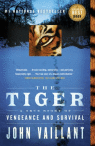


A True Story of Vengeance and Survival
Written by John Vaillant

Format: Trade Paperback, 352 pages
Publisher: Vintage Canada
ISBN: 978-0-307-39715-7 (0-307-39715-7)
Pub Date: May 3, 2011
Price: $22.00
|
|||

It's December 1997 and a man-eating tiger is on the prowl outside a remote village in Russia's Far East. To the horrified astonishment of a team of hunters, it emerges that the attacks are not random: the tiger is engaged in a vendetta.
Injured and starving, it must be found before it strikes again, and the story becomes a battle for survival between two main characters: Yuri Trush, the lead tracker, and the tiger itself.
Culminating in a showdown deep in the Siberian forest, The Tiger is a haunting, spellbinding tale of a hunt to the death; of man and nature in collision; of the ancient relationship between predators and prey; and an intimate portrait of a remarkable animal and its increasingly threatened world.

WINNER 2011 - British Columbia's National Award for Canadian Non-Fiction
FINALIST 2010 - Banff Mountain Book Festival Award
Vladimir Schetinin, the former head of Inspection Tiger, and an expert on Amur tiger attacks, has accumulated a number of stories like this over the past thirty years. “There are at least eight cases that my teams and I investigated,” he said in March of 2007, “and we all arrived at the same conclusion: if a hunter fired a shot at a tiger, that tiger would track him down, even if it took him two or three months. It is obvious that tigers will sit and wait specifically for the hunter who has fired shots at them.”
The caveat here is that each of these eight cases met the following conditions: namely, that the tiger was able to identify its attacker, had the opportunity to hunt him, and was temperamentally disposed to do so. In its brief reference to tiger attacks on humans, Mammals of the Soviet Union states that “Usually animals shot and wounded or chased by hunters attacked, and only very rarely did an attack occur without provocation.” Such responses are, in themselves, examples of abstract thinking: tigers evolved to respond to direct physical attacks from other animals; they did not evolve to respond to remote threats like guns. Nor do they innately understand what guns are or how they work. So to be able to make the multistep connection between a random explosion in the air, a pain it can feel but often cannot see, and a human who may be dozens of yards away is, almost by definition, an abstraction. While many higher animals are capable of making this association, very few will respond like a tiger. If you combine this with a long memory, you can have a serious problem on your hands.
Chris Schneider, an American veterinarian based in Washington state, has had personal experience with the tiger’s capacity for holding a grudge. Over the course of his career, Schneider has treated many circus animals, including tigers, sometimes giving them sedatives in the form of a painful shot in the rump. A year might go by before these tigers passed through town again; nonetheless, the moment he showed up, their eyes would lock on him. “I’d wear different hats; I’d try to disguise myself,” Schneider explained, “but when I’d walk into the room, the cat would just start following me, turning as I walked around them. It was uncanny.” He described the impact of these tigers’ gaze as “piercing.” “They looked right through you: a very focused predator. I think most of those cats would have nailed me if they could have.”
From the Hardcover edition.
Review Quotes
"A provocative and comprehensive examination of the plight of the wild tiger.... Breathtakingly exciting."
--The Vancouver Sun
"Remarkable.... Recounts with power and excitement the true story of a titanic confrontation.... A tale of astonishing power and vigour.... Read it and be afraid. Be very afraid."
--The Globe and Mail
"A superb book--hyper-intelligent, wonderfully well-written, with a great cast, both human and animal, and at its heart, [an] amazing and truly chilling story."
--Daily Mail
"A grand addition to the animal-pursuit subgenre.... Few writers have taken such pains to understand their monsters, and few depict them in such arresting prose."
--The New York Times Book Review
"Riveting, full of fascinating details about a land and people that time forgot. And the most compelling character of all may be the suspect tiger himself."
--The Daily Beast
Find out more at www.thetigerbook.com
Prologue
Part One | Markov |
Part Two | Pochepnya |
Part Three | Trush |
Epilogue
Acknowledgments
A Note on Translation
Notes
Selected Bibliography
From the Hardcover edition. About this Author
JOHN VAILLANT's first book was the national bestseller The Golden Spruce, which won the Governor General's Literary Award for Non-Fiction, as well as several other awards. He has written for The New Yorker, The Atlantic, Outside, National Geographic and The Walrus, among other publications. He lives in Vancouver, British Columbia, with his wife and children.
From the Hardcover edition.

Upgrade to the Flash 9 viewer for enhanced content, including the ability to browse & search through your favorite titles.
Click here to learn more!
